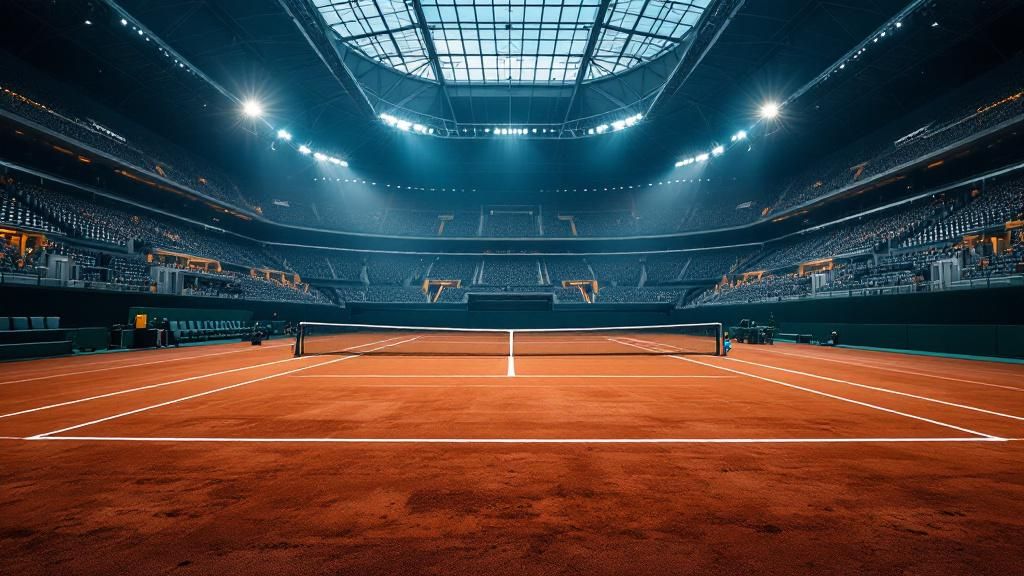

Real Madrid’s iconic Bernabeu stadium will host a practice facility for the world’s leading tennis players prior to the Madrid Open next month. The esteemed stadium will temporarily swap grass with clay between 23 and 26 April, offering elite competitors such as Spanish world number one Carlos Alcaraz an occasion to refine their readiness for one of the professional game’s major events outside of the Grand Slams. The practice sessions, which will replicate the clay surfaces utilised at the tournament’s main venue, the Caja Magica, will remain open to the public. The Madrid Open, which takes place from 20 April to 3 May, combines both the ATP and WTA tours, making it one of the sport’s leading combined events.
A venue adapted for tennis
The choice to use the Bernabeu constitutes an forward-thinking solution to a growing logistical challenge confronting the Madrid Open. The tournament’s growth to singles draws featuring 96 players contested across a fortnight, combined with the inclusion of doubles events, has stretched the capacity of the Caja Magica past its practical limits. By gaining entry to one of world football’s most recognisable stadiums, organisers have managed to accommodate the tournament’s ambitious growth whilst maintaining the standard of training amenities accessible to the world’s leading competitors.
Tournament director Feliciano Lopez stressed that the move serves a genuine sporting purpose rather than simply operating as a marketing exercise. “The goal is to have a dedicated practice surface which helps them – it’s not just a commercial opportunity,” the three-time Wimbledon quarter-finalist said to BBC Sport. Lopez noted that following the announcement of the deal, he has received numerous enquiries from players and coaching teams keen to utilise the facility. Real Madrid do not have any home matches planned during the week when their newly renovated stadium will be transformed for tennis purposes.
- Practice sessions open to elite players during 23-26 April
- Court surfaces will exactly replicate the Caja Magica clay
- Public access to practice sessions will not be permitted
- Tournament matches will continue exclusively at Caja Magica venue
Why Madrid Open needed additional facilities
The Madrid Open has gone through a considerable transformation in the past few years, evolving from a traditional tournament into one of professional tennis’s most forward-thinking and innovative events. The expansion to 96-player singles draws held over a fortnight, alongside the introduction of comprehensive doubles competitions, has created significant strain on available infrastructure. Tournament officials found themselves confronted with a real capacity problem at their long-time venue, the Caja Magica, which could not accommodate the expanded draw whilst maintaining the high standards required by the world’s elite players and their support staff.
This expansion reflects the tournament’s rising prominence and financial attraction within the elite tennis circuit. As one of the most significant events outside the Grand Slam events, the Madrid Open draws the sport’s leading competitors and generates substantial global interest. However, this success created a contradiction: the very popularity that made the tournament so prized also pressured its infrastructure capacity. Tournament director Feliciano Lopez recognised that innovative solutions were vital to maintain the event’s trajectory and keep drawing top-tier participation from both ATP and WTA tours.
Moving past the initial space
The Caja Magica, positioned about five miles south of central Madrid, has been the Madrid Open’s home for a considerable period. However, the venue’s shortcomings grew more evident as the tournament increased in scale and ambition. The facility, whilst suitable for the tournament’s traditional format, had difficulty providing enough practice facilities and training facilities for the dramatically enlarged player group now competing in the event. This constraint risked undermining the quality of preparation accessible to competitors.
By gaining entry to the Bernabeu, organisers have efficiently resolved this logistical puzzle whilst simultaneously generating significant marketing value. The iconic football stadium’s conversion to a tennis installation demonstrates innovative solution-finding at the most senior operational tier. The setup enables the event to preserve its competitive integrity and player satisfaction whilst maintaining its expansive expansion path, guaranteeing the Madrid Open continues as one of elite tennis’s most prized and comprehensively supported competitions.
Real Madrid’s sporting ambitions expand
Real Madrid’s decision to host a practice court at the Bernabeu constitutes a strategic expansion of the club’s athletic interests beyond football. The 15-time European Cup winners have demonstrated their commitment to adopting forward-looking alliances that boost their iconic stadium’s global profile. By welcoming the world’s leading tennis talent to one of sport’s most celebrated grounds, Real Madrid has established itself as a progressive institution capable of hosting premier competitions across various sports. This move aligns with the club’s overarching strategy of the Bernabeu as a diverse athletic hub, in the wake of its recently completed renovation that transformed it into a state-of-the-art facility.
The structure carries limited interference to Real Madrid’s competitive schedule, as the club has carefully scheduled the tennis court installation to avoid major domestic fixtures. Should Real Madrid progress through the Champions League quarter-finals in their Bayern Munich tie, any following encounters with Liverpool or Paris St-Germain would be played away from home throughout that timeframe. This meticulous planning ensures the football club’s competitive interests stay protected whilst continuing to exploit the business and marketing prospects presented by hosting one of tennis’s leading events. The collaboration illustrates the way modern sports organisations can leverage their facilities and established reputation to enhance their standing within the broader sports ecosystem.
| Feature | Details |
|---|---|
| Practice court dates | 23–26 April 2026 |
| Tournament dates | 20 April – 3 May 2026 |
| Court surface | Clay, matching Caja Magica specifications |
| Public access | Not open to spectators |
Tournament director Feliciano Lopez has been clear that this arrangement represents a legitimate competitive venture rather than a cosmetic commercial venture. The former world number 13 has received considerable interest from competitors and coaching staff eager to use the Bernabeu’s practice facilities during their tournament preparations. Lopez’s vision focuses on concrete value for competitors, guaranteeing the partnership supports the competition’s sporting standards and competitor welfare above all other factors.
Marketing innovation meets real-world application
The Madrid Open has long established itself as a competition keen to challenge boundaries and challenge convention within professional tennis. From unveiling an striking blue clay surface to using fashion models as ball persons, the tournament has consistently sought to capture global attention through creative ventures. Director Feliciano Lopez has stressed that the organisation prides itself on innovative approaches and embracing strategic risk-taking to provide fresh opportunities for players and spectators alike. This latest project at the Bernabeu represents the logical progression of that approach, combining the iconic venue’s global profile with authentic performance advantages.
Beneath the prestigious surface of hosting matches at one of global tennis’s most prestigious venues lies a genuine requirement driving the decision. The Madrid Open’s expansion to 96-competitor singles draws contested over a two-week period, alongside extensive doubles competitions, has quickly exceeded the Caja Magica’s capacity. By leveraging the Bernabeu’s spacious facilities for competitor training, organisers address genuine logistical constraints whilst simultaneously generating significant promotional value. This dual approach ensures the partnership delivers substantive benefits to competitors rather than functioning purely as a promotional exercise divorced from sporting reality.
- Blue clay surface implemented to improve the visual presentation and television presentation
- Fashion models utilised as ball kids throughout recent tournament editions
- Virtual tournament conducted during the 2020 pandemic on gaming consoles
- Tournament expansion demands supplementary facilities surpassing Caja Magica capacity
- Practice court installation fulfils player preparation needs authentically
Exploring prospects for tennis at the Bernabeu
Whilst the present arrangement focuses exclusively on practice facilities, the success of this opening partnership could potentially reshape how the Madrid Open functions in future years. Tournament director Lopez has been mindful to temper expectations, remarking that hosting tournament matches at the Bernabeu remains outside the organisation’s immediate plans. However, the benchmark created by other major tournaments must not be wholly discounted. The Miami Open’s addition of a showcase court within the Hard Rock Stadium illustrates that such configurations are feasible at world-class sporting venues, should circumstances and operational factors align favourably in later editions.
For now, the emphasis remains firmly on providing measurable advantages to the global top players during the critical training stage before the principal event starts at the Caja Magica. The availability of a world-class practice venue at one of global sport’s most iconic stadiums represents an remarkable opportunity for players to fine-tune their clay-surface techniques. Whether this proves a single event or the basis for a sustained partnership will in the end hinge on how well the scheme addresses player needs whilst preserving the tournament’s reputation for creativity and excellence.
